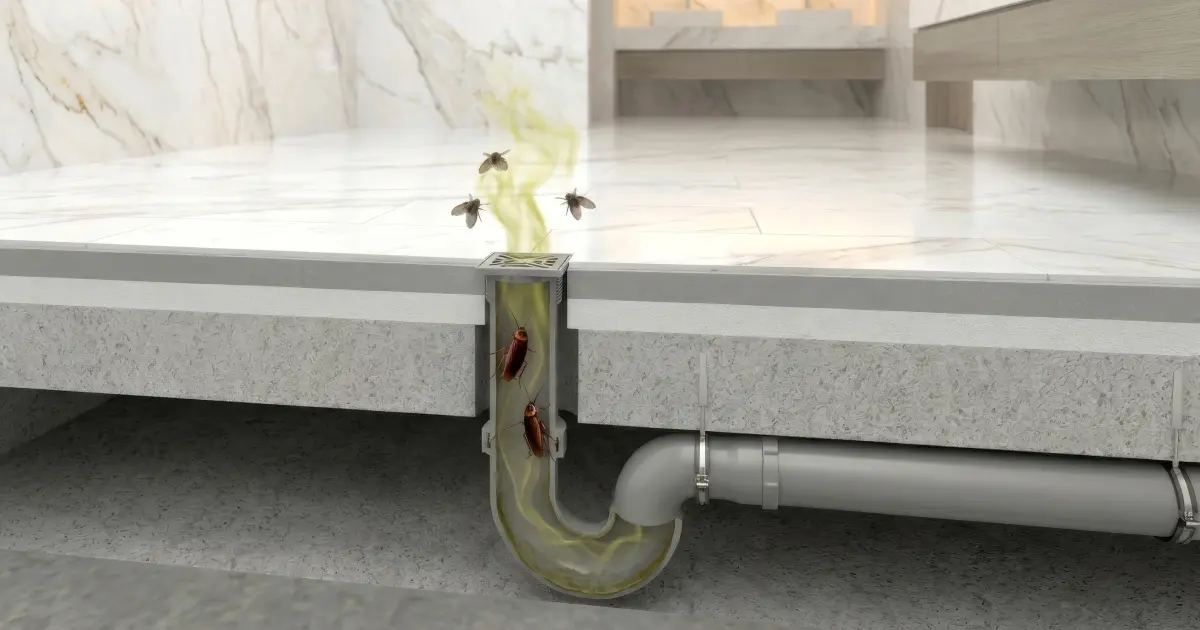
Every waterless trap seal on the market makes the same basic promise: block sewer gas without water. But the mechanism matters. The material matters. The engineering tolerances matter. This article explains exactly how Green Drain works, from the physics of the one-way valve to the material science behind its medical-grade silicone construction, and why those details determine whether a drain seal actually performs in the field.
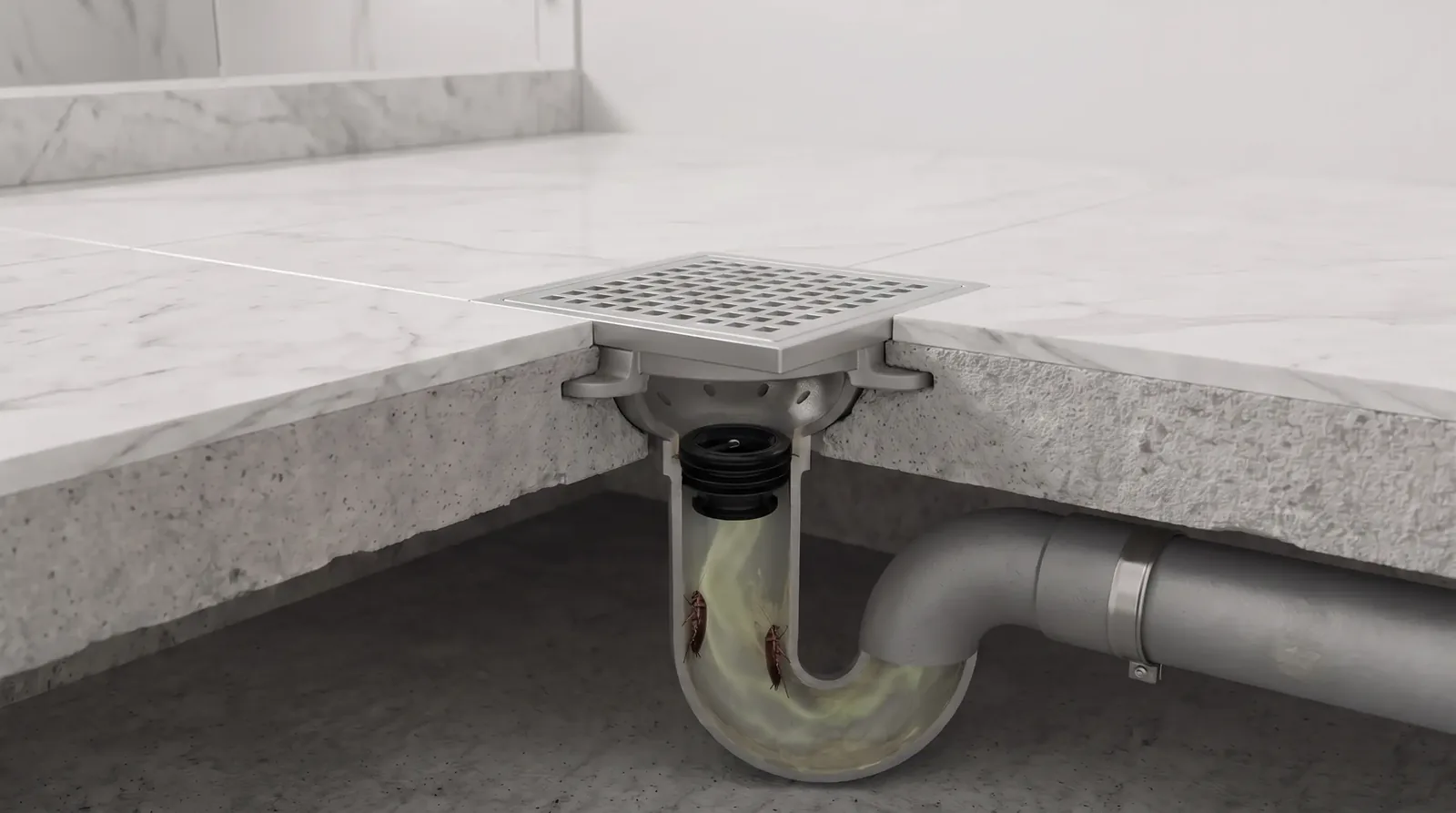
If you have ever wondered what happens inside a Green Drain when water flows through it, when the flow stops, or when sewer gas pushes up from below, this is the technical breakdown.
The one-way valve principle
Green Drain operates on a simple mechanical principle: a flexible silicone valve, often called the skirt, that opens in one direction and seals shut in the other. The device sits inside the drain body, below the grate. When water flows downward from mopping, cleaning, or equipment drainage, the skirt flexes open and allows water to pass through unrestricted. When the flow stops, the skirt returns to its closed position under its own elastic memory.
This creates a physical barrier between the building interior and the sewer system. Unlike a P-trap, which relies on a pool of water that can evaporate, the Green Drain seal is mechanical. It does not evaporate, it does not require replenishment, and it does not depend on regular water flow to maintain its function.
Opening force: 32 grams
One of the most critical design parameters in a one-way drain valve is the opening force: how much pressure is required to push the valve open. If the opening force is too high, the valve resists water flow and can cause backups or slow drainage. If the opening force is too low, the valve may not seal reliably against sewer gas pressure from below.
Green Drain's silicone valve is engineered to open at just 32 grams of force. This is roughly the weight of six nickels resting on the valve surface. In practical terms, it means the valve opens under the slightest water flow, including condensation runoff from HVAC equipment and small cleaning spills. There is no scenario in normal building operation where the valve impedes drainage.
Why 32 grams matters: Some competing products use heavier spring mechanisms or rigid flaps that require significantly more force to open. This can cause water to pool above the drain during low-flow conditions. Green Drain's ultra-low opening force ensures the valve never becomes a bottleneck, even during passive drainage events.
The seal in the other direction
While the valve opens easily from above, it resists pressure from below. When sewer gas pushes upward against the closed skirt, the gas pressure actually presses the skirt tighter against the housing, improving the seal. This is the same principle used in check valves throughout plumbing engineering: the greater the backpressure, the tighter the closure.
This bidirectional asymmetry, easy to open from above and self-reinforcing from below, is what makes the one-way valve effective as a permanent gas barrier.
Flow rate: over 340 L/min
A drain seal that blocks gas but restricts water flow is not a viable solution for commercial buildings. Floor drains in commercial kitchens, healthcare facilities, and industrial spaces routinely handle high-volume water events: equipment washdowns, floor cleaning, emergency water discharge.
The 4-inch model (GD4) is tested to an unrestricted flow rate of 340 L/min or more (89.8 GPM). That is well above the certification minimum: ASME A112.6.3 requires 276.3 L/min (73 GPM) for 4-inch drains, and in ASSE 1072 testing the GD4 sustained that required rate for 10 continuous minutes without overflow. The testing is conducted in accordance with ASME A112.6.3 and ASSE 1072 standards, the same protocols used to certify the drain bodies themselves.
Flow rates for other sizes scale proportionally. The GD2 (2-inch) handles the flow requirements of smaller fixture drains, while the GD6 (6-inch) is designed for large-format industrial and commercial drains. Full flow data for all sizes is available on the specifications page.
Material: medical-grade silicone
The silicone valve is the component that makes or breaks a waterless trap seal. It must remain flexible across a wide temperature range, resist chemical degradation from cleaning products and sewer gases, prevent biological growth, and maintain its elastic memory over thousands of cycles. Green Drain uses medical-grade silicone rubber for the valve, a deliberate material choice with specific engineering reasons.
Why silicone, not rubber
Natural rubber and synthetic rubbers (EPDM, neoprene) are common in plumbing applications. They are cheaper than silicone. But they have significant disadvantages in a drain environment:
- Chemical resistance: Rubber degrades when exposed to hydrogen sulfide, ammonia, and the organic acids present in sewer gas. Silicone is inert to these compounds.
- Temperature range: Green Drain's silicone is rated from -40 degrees F to 212 degrees F (-40 to 100 degrees C) and stays flexible across that full range. Rubber becomes brittle at low temperatures and softens at high temperatures.
- Elastic memory: Silicone returns to its original shape after deformation with virtually no compression set over time. Rubber develops permanent deformation, meaning the seal loosens progressively.
- Biological resistance: Silicone does not support microbial growth. Rubber can harbor bacteria and biofilm in its porous surface structure.
Why medical-grade specifically
Medical-grade silicone is manufactured under stricter controls than industrial or food-grade silicone, with tighter tolerances on purity and material consistency. The durability evidence is in the independent test data: CRT Laboratories measured a tear strength 93 times the ASSE 1072 minimum requirement, and the material is rated for continuous service from -40 degrees F to 212 degrees F.
For a drain seal, the practical benefit is consistency. Every batch of medical-grade silicone meets the same hardness, tensile strength, and elongation specifications. There are no filler materials, no recycled content, and no batch-to-batch variation that could affect valve performance. This matters because the valve must maintain its 32-gram opening force and its sealing integrity through thousands of open-close cycles in demanding environments.
Durability: 2,500+ cycle testing
Green Drain's silicone valve is tested through more than 2,500 open-close cycles as part of the product testing program. Each cycle simulates a full water-flow event: the valve opens under flow, the flow stops, and the valve returns to its sealed position.
At the conclusion of cycle testing, the valve is retested for seal integrity. The opening force is remeasured. The flow rate is reverified. The gas-blocking performance is confirmed. The results show no measurable degradation in any performance parameter after 2,500+ cycles.
Cycle testing is a standardized durability result, not a service-life promise, and Green Drain does not publish a working life in years. Actual life depends on drain traffic, chemical exposure, and water temperature. The practical guidance is inspection-based: inspect the seal at 6 to 12 months in service to confirm the silicone is intact and sealing properly, and replace only as needed. High-use drains wear sooner, while low-use drains often last a year or longer.
Compare to trap primers: Mechanical trap primers use solenoid valves, pressure regulators, and distribution tubing that typically require maintenance or replacement every 3 to 5 years. Electronic trap primers add circuit boards, sensors, and power connections to the failure equation. Green Drain has no powered or plumbed components at all: no solenoids, no circuit boards, no supply connections.
How it blocks gas, odors, and pests
The sealed valve creates three distinct barriers:
Gas and odor barrier
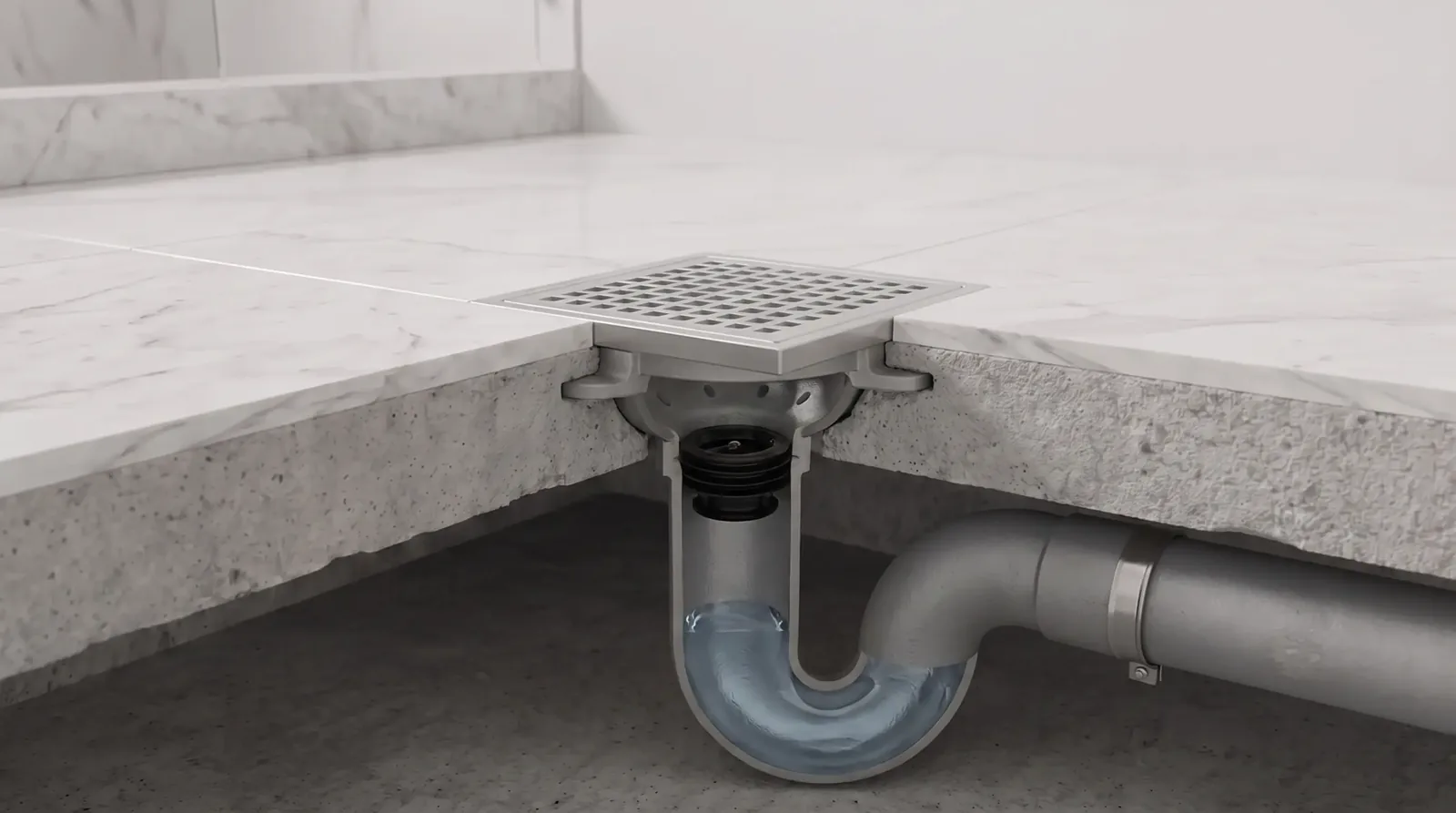
When the silicone skirt is in its closed position, it forms an airtight seal across the drain opening. Sewer gases, including hydrogen sulfide, methane, and ammonia, cannot pass through the closed valve. Independent testing confirms that Green Drain meets the gas-blocking requirements of ASSE 1072-2020, the industry standard for floor drain trap seal devices.
Pest barrier
The closed valve also creates a physical barrier against pests. Drain flies, cockroaches, mosquitoes, and other insects that travel through sewer lines cannot pass through the sealed silicone valve. Unlike chemical pest treatments that must be reapplied and may not be permitted in certain facilities, the physical barrier is continuous and passive.
Backflow resistance
While Green Drain is not a backflow prevention device (those are regulated separately under plumbing codes), the one-way valve does provide resistance against minor backflow events. During temporary surcharging of the sewer system, the valve remains closed and prevents sewer water from backing up through the drain. For facilities that experience occasional backflow, this provides an additional layer of protection beyond the gas seal.
The 30-second installation
Green Drain installs by dropping the device into the existing floor drain body after removing the grate. There are no tools required, no plumbing modifications, no adhesives, and no threading. The device is sized to fit standard drain bodies, and the slight compression fit of the outer housing holds it in position.
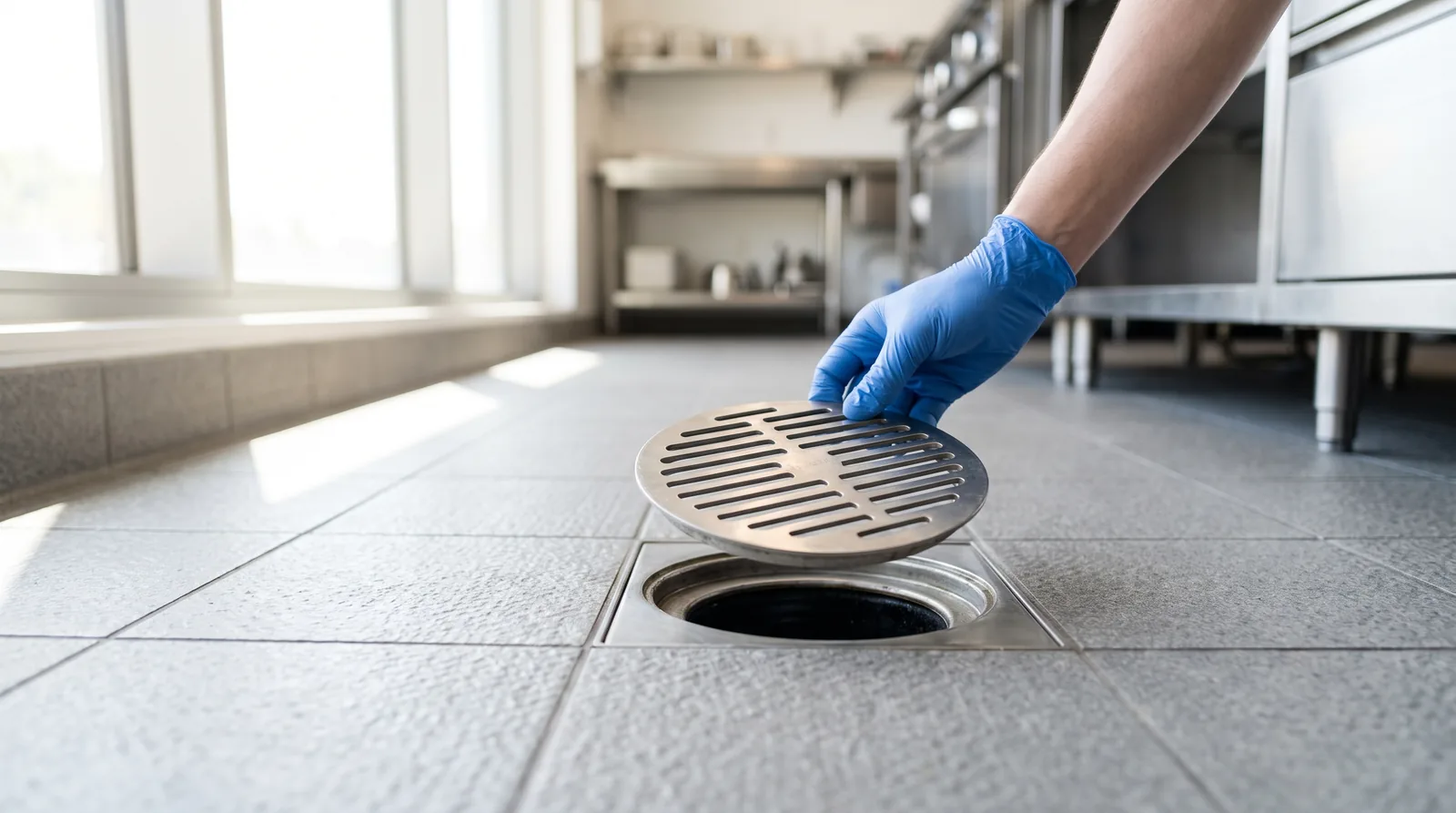
The installation process is three steps:
- Remove the drain grate. Lift or unscrew the existing floor drain grate.
- Drop in the Green Drain. Push it into the pipe by hand, skirt first, until it sits 2 to 4 inches (50 to 100 mm) below the top of the pipe. The silicone gasket creates a snug seal against the pipe walls.
- Replace the grate. Set the grate back on top. Installation is complete.
This simplicity has a direct operational impact. A single facility technician can install Green Drains across an entire building in a single shift. There is no need to schedule plumbing contractors, shut down water systems, or take spaces offline. For hospitals, schools, and hotels where drain access time is limited, the 30-second installation eliminates the logistical barriers to comprehensive drain sealing.
Certifications and standards compliance
Green Drain holds six third-party certifications, backed by independent test reports from SGS, DTI, and CRT. The five product-standards certifications relevant to its function as a trap seal device are:
- cUPC listed (IAPMO R&T) as a trap seal device for use in the United States and Canada
- NSF/ANSI 2 certified for food equipment, allowing installation in food-service environments
- WaterMark certified for Australian plumbing systems (IAPMO Oceania)
- CE Mark / ETA-18/0536 European Technical Assessment for waterless odour traps
- Saber certified for the Saudi Arabian market
These are third-party certifications, not self-declarations. Each requires independent testing to published standards, with ongoing surveillance audits to maintain the listing. The sixth certification is HACCP International food safety certification, covering use in food safety management systems. Green Drain's performance is also tested against ASSE 1072-2020, the standard for barrier-type trap seal protection devices. Full certification documentation is available on the certifications page and in the specification submittals.
Sizing and compatibility
Green Drain is manufactured in eight standard sizes, from 1.25-inch (GD125) through 6-inch (GD6), plus international models. The four most commonly specified for commercial and institutional drain bodies are:
- GD2 - 2-inch, for smaller fixture drains and condensate lines
- GD3 - 3-inch, for standard restroom and corridor floor drains
- GD4 - 4-inch, for commercial kitchen, healthcare, and industrial floor drains
- GD6 - 6-inch, for large-format industrial and trench drains
The sizes correspond to the internal diameter of the drain body, not the pipe size or the grate size. Sizing guidance for specific drain manufacturers and models is available from the Green Drain technical team. Request a quote with your drain specifications for sizing confirmation.
Frequently asked questions
How does Green Drain work?
Green Drain uses a one-way silicone valve that sits inside the drain body. When water flows down, the valve opens with just 32 grams of force. When flow stops, the silicone skirt returns to its closed position under its own elastic memory, creating a physical seal that blocks sewer gas, odors, and pests from traveling back up through the drain.
What is Green Drain made of?
Green Drain has three components: an ABS plastic housing, a one-way valve made of medical-grade silicone rubber (sometimes called the skirt), and a silicone compression gasket that seals against the pipe wall. The medical-grade silicone resists chemicals, heat, and biological degradation, is tested to 93 times the minimum tear strength requirement, and is rated from -40 degrees F to 212 degrees F.
How long does Green Drain last?
The silicone valve is tested to over 2,500 open-close cycles (ASSE 1072) with no measurable degradation in sealing performance. Green Drain does not publish a service life in years, because actual life depends on drain traffic, chemical exposure, and water temperature. Inspect the seal at 6 to 12 months in service to confirm the silicone is intact and sealing properly, and replace only as needed.
Does Green Drain restrict water flow?
No. The 4-inch model (GD4) is tested to an unrestricted flow rate of 340 L/min or more (89.8 GPM), well above the 276.3 L/min (73 GPM) minimum that ASME A112.6.3 requires for 4-inch drains, a rate it sustained for 10 continuous minutes in certification testing. The silicone valve opens fully under water pressure and does not create a bottleneck. Testing is conducted per ASME A112.6.3 and ASSE 1072 standards.